
Cooking With Love
Everything Tastes Better At The Campground


There Was An Attempt…
I grew up relatively poor, so “meals” to us growing up were what we could put together with whatever scraps we had in our cabinets. Our cabinets at the end of the week were mostly bare. Meals consisted of hot dogs on white bread, peanut butter & jelly, bologna & cheese, etc. When my Mom had a little extra time to throw together Chicken Tonight, it was a good day. Especially when my family and I sang the jingle and did the dance from the commercial. Click the link, I dare you, you’ll never get that song out of your head. Very rarely, we’d get a pizza from the local pizza joint, and it was a huge treat (I still LOVE their sausage pie!). Unfortunately though, I was never really taught how to cook because my parents worked around the clock. I tried to cook a frozen apple pie from the grocery store once, and I didn’t consider that the pie pan would be hot when I took it out of the oven, so I dropped it. That amish apple pie turned into apple charcoal, and to this day, I can’t get that smell out of my head. I didn’t eat apple pie for probably 15 years after that. My first REAL foray into cooking was in high school home-economics class. I did….ok….to say the least.
Fast forward many many years, and I tried to cook for my fiancee (now wife), which was also met with the same underwhelming result. You ever see someone serve rice and forget to drain most of the water? Ever see eggs that were so awfully cooked, they turned black and greasy? Yup, that was me. Still to this day I have no idea how I didn’t kill us.
After we got married, we also didn’t have a lot of money, but did have basic cable, so to entertain ourselves, we watched a LOT of Food Network and food tourism shows. Iron Chef, Chopped, Alton Brown, Bobby Flay, Anthony Bourdain, Man vs. Food, Guy Fieri, and so on. I realized that cooking really wasn’t as hard as I made it, it was just about memorization, technique, commitment, consistency, and learning through repetition. Well, basic cooking skills that is.
Determined To Ditch Black & Oily Eggs
Thats really all it took. I started cooking regularly. I started by trying to cook eggs a bunch of ways. Fried, poached, over easy, under, french style, scrambled, omelettes, and so on. Once I was able to successfully make eggs regularly, I moved on to other breakfast items like pancakes and waffles, and then meats, some cultural foods, baked goods, and the rubber REALLY started to hit the road.
I learned to make my own pretzel buns for burgers and hot dogs, sticky buns, cakes, cookies, and tons of other things. I had a miles long list of favorites on AllRecipes (before it started to suck). I even had a journal I started writing some of these recipes down!
After a while I started experimenting more with my recipes as I understood what each ingredient was for, and what could substitute it. Did you know you can substitute eggs with applesauce in baked goods if its used as a moisturizer? Not if its a binder! I tried it, and its AMAZING!
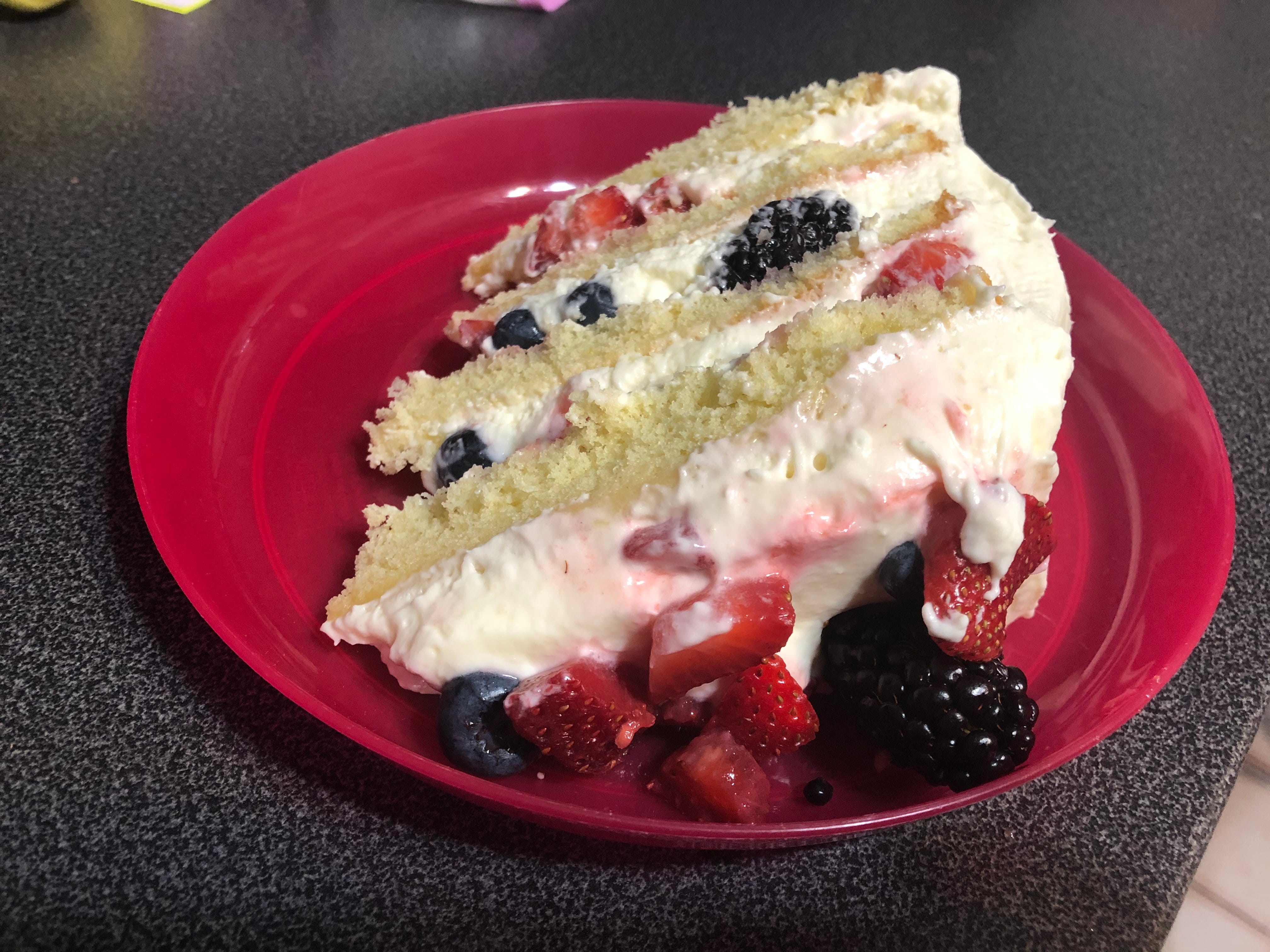
The best thing i’ve ever made was a 4 layer berry chantilly cake, pictured below. I hadn’t QUITE figured out how to properly ice a cake yet, hence the berries falling off the top. But i’m a lot better now and plan on making this again this summer. I’ve come a long way!
The Awakening of the Griddle
Now, I try to cook at home when I have the time and energy, which isn’t common for me to have both. Energy, sure. Time? Not so much. We do takeout probably more than we should at home, and my wallet cries. However, on camping trips? The amateur cook in me grabs a spatula and gets back to work.
At the beginning of the 2022 camping season, we were camped near a Walmart. We went to pick up a few groceries, and I saw that they had a major sale on outdoor cooking equipment. So there I was, up in the mountains, loading a 22” portable Blackstone griddle into my cart with all of the necessary tools. We took it straight back to the campground, got it cleaned up and seasoned, and fired it right up!
I have to admit, I had my preferences for cooking tools, seasonings, and equipment when making things at home. However, I never really cared about outdoor cooking. Grill, griddle, charcoal, or gas. I never cared much. Whatever cooked the hot dog or hamburger. I never really understood what the fascination was about Blackstone, but I knew I needed something large enough that would fit food for a family of 4 on it ,and allow me to lug it around on camping trips. It was more expensive than other camp grills and griddles, but I was curious about the rave reviews, and decided to take the leap.
I quickly discovered how much I loved cooking on a flat top, how much better it is than a traditional grill, and happily joined the cult of Blackstone. All hail our properly seasoned leader.
There are few things in life as glorious as the smell of cooking pancakes, bacon and eggs on the griddle while sipping a nice cup of coffee while you listen to the birds at the campsite. Once I made breakfast on it the first time, I was sold.
Campground Cooking Should Be Simple & Diverse
I read posts on various platforms of people asking for recommendations for menus because they’re sick of burgers and dogs, or sick of peanut butter and jelly, or what have you.
If you’re one of those people…please….pick up a griddle. Quite literally anything edible can be griddled. It doesn’t have to be a Blackstone, or even very large, but i’d definitely recommend it because of MASSIVE variety of foods you can cook on it, and the ecosystem of tools available. Blackstone has a fantastic Youtube Channel that teaches you a lot about how to cook on and season your griddle, i’d highly recommend it! As a note, campfire cooking on open flame is an entirely different discussion, equally as delicious, but for this context, we’re going to focus solely on griddle cooking with propane.
So what can you cook on a griddle?
Pasta? Put the pot of water right on the griddle
A muffin? Slice it in half, and griddle face down with some butter.
Steak? Please do.
Chicken? Butterfly, and griddle your heart out.
Rice? Just like pasta, put the water in a pot on the blackstone and go to town!
Vegetables? Absolutely!
Ice Cream? You thought I was kidding, weren’t you? I’m not.
So, so so, much more.
The key to successful campground cooking is simplicity and diversity. You want simple dishes that are easy to make, easy to store, easy to re-heat, and easy to clean. You also don’t want to be eating the same things over and over and over again. When you’re camping, you’re adventuring into the wilderness, why not adventure and experiment with your cooking skills? There are so, so, so many different things you can cook on griddles. Every time I experiment and think it’s going to fail, it succeeds, spectacularly.
You can surely do burgers, dogs, brats, etc. Typical backyard food. Nothing wrong with that. But they don’t go as far in most cases, and can get really boring.
Let’s try a few new things here, shall we?
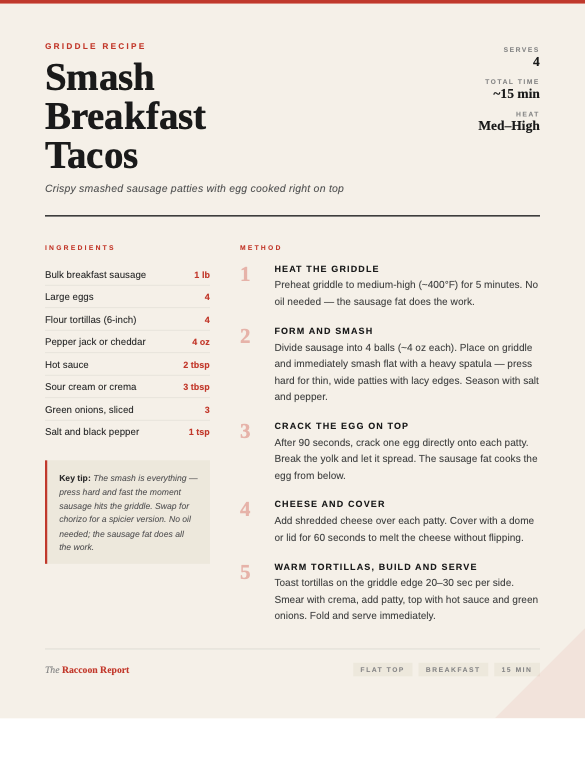
BREAKFAST : Smashed Breakfast Tacos
This is a unique take on a traditional eggs & sausage breakfast. It uses ingredients you’re probably already stocking in your camper, but assembles them in a way that gives you a break from traditional breakfasts. You can make multiples quickly, and they’re absolutely delicious. “Bulk sausage” can be a raw whole sausage roll, or as a good alternative, you can buy sausages in casing like sweet italian or hot italian, slice the casing, peel it off, and you now have bulk sausage. NOTE: If you do use a more spice heavy sausage like italian, or mexican chorizo, adjust your toppings that fit the profile a bit more. If you go italian, use parmesan or mozzarella cheese, if you go mexican, pepper jack works, but you can sub with cojita or monterey jack.
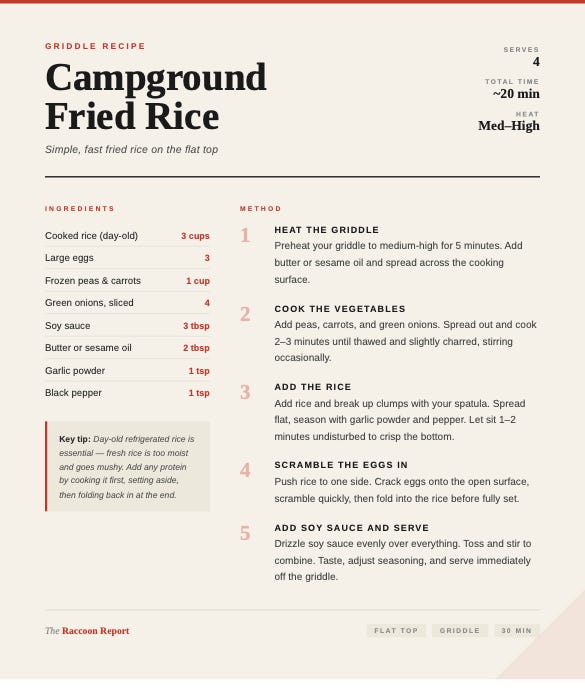
Lunch/Dinner: Campground Fried Rice
“What the heck are green onions?” I can already hear it. I’m a huge fan of green onions. They’re a lot cheaper, easier to store, and more flexible than debating on whether a white or yellow onion will work better in a recipe. Some may know the top part of a green onion by its other name…”chive”. I used green onions in a recipe once because we had them, for some odd reason, and i’ll never go back. They aren’t as in your face as traditional onions, but still give that onion flavor. In regards to frozen veggies, you don’t have to use peas and carrots. We sometimes use broccoli, eggplant, whatever we have on hand. I read once that fried rice was a way to get rid of leftovers. You can also throw chicken in here, sliced beef, whatever you have!
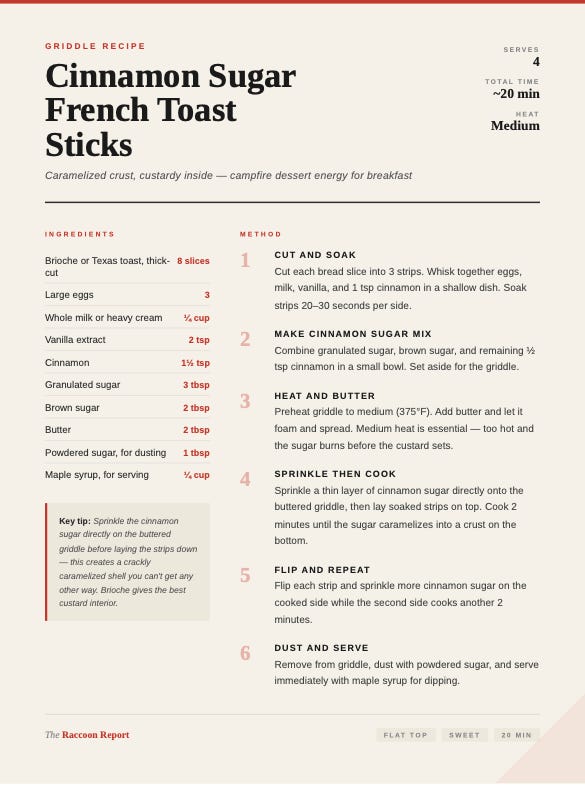
Brunch: Griddled Cinnamon & Sugar French Toast Sticks
This one, admittedly, is a bit more than simple because of the ingredients involved. Assuming you have some leftover bread, butter, and syrup from other breakfasts, the rest of the ingredients may be a bit more uncommon in your camper like vanilla, brown sugar, etc. Luckily, most of the ingredients have a really long shelf life, and if you have the storage for outdoor cooking tools and ingredients, keep them on hand! Vanilla has many uses, as does sugars and cinnamon.
That’s 3 recipes mostly made from things you’ll have on hand, or are easy to get at any grocery store. Personally, I try to always stay within 30 mins of a grocery store having small children. When they’re much older and grown, we’ll head out deeper into the wilderness for boondocking trips, but until then, we’re tethered to the local grocers.
Simple Setup = Simple Cooking
That same principal extends to your cooking setup. Your cooking setup should be as minimalist as possible, easy to store and travel with, and provide as little friction for you as possible.
Personally, i’m not a fan of most outdoor cooking prep stations on campers. They’re more form over function, and more often, cause more problems than they solve. In addition, i’d MUCH rather have that space for storing whatever I want rather than an outdoor sink i’ll use once in a while.
If you’re in an RV, chances are, you’re probably going to try and cook with propane. Most modern RV’s come with a propane quick connect, which make it so that you don’t have to lug a heavy propane bottle around your campsite. Just make sure you have a propane hose long enough to connect to it, and keep your cook station a fair distance away from your camper for safety purposes. I see people either using the outdoor kitchen or attaching their own cook tops WAY too close to a rig made mostly of wood, and it gives me serious anxiety. We use a 25’ propane quick connect hose, and our griddle typically stays on the OUTSIDE of our awning (so the rising heat doesn’t damage it), unless its raining. Granted, a Blackstone retains heat pretty well in the cook top, but never take chances!
Even though most griddles say “tabletop”, i’m still very worried about heat transfer, and use a GCI Outdoor cook table. That table has been through some things bouncing around in the back of my truck for the last few years! It folds up REALLY nicely, has a carrying handle, and very strong once its setup. I put the blackstone on top, and have space for tools, bowls, etc. It also cleans up really nicely with a paper towel & vinegar, or if you want to go nuclear, some sanitation wipes. The foldout counters are hard plastic with metal arms, and the top is metal slats .
I also have another side table that I use for prep and ingredient positioning while getting meals ready. Its another table similar to the GCI (I can’t find a link to the other table), with a larger top. Admittedly, I would like just a flat table instead another table with a bunch of fold out counters to make prep SLIGHTLY easier, but it helps, nonetheless.
Both of my tables fold up nicely on top of each other, and take up minimal space in the truck. I also have a griddle tool bag, similar to this one on Amazon. In my toolbag, I carry my spatulas, tongs, egg rings, squirt bottles for water and oil, and a spatula mat. I also carry a few basic spices that are used in most of what I cook.
Keep the setup simple! Here’s the list of what I carry for cooking:
2 minimalist cook/prep tables that fold up small
1 22” blackstone griddle with lid
Transported in a black, heavy duty, zipper carrying bag with handles
I have a ran cover zipped around it
1 tool bag with cooking tools & spices:
3 Metal Spatulas (1 wide spatula, and 2 thinner ones)
1 set of medium sized locking tongs
4 Egg rings (2 small and 2 large)
Silicone tool rest/spatula mat (a thick paper towel works too)
Grease catcher (attaches to the blackstone)
Spices
Kosher salt (sea salt can be used too, but I prefer kosher)
Black pepper
Garlic powder
Cinnamon
Vanilla
Avocado oil for cooking and/or seasoning - I prefer it. It has a higher smoke point, is healthier than some seed oils due to its fat content, burns cleaner, and has a relatively neutral taste. Have you ever had avocado cake frosting? Or avocado ice cream? No? You’re DEFINITELY missing out. The Avocado is an unsung heroine. I use this as a seasoning layer after each cook.
Blackstone griddle seasoning for seasoning after a full scrub down. I scrub down the griddle top once or twice a season, and season with the Blackstone stuff. Its more expensive than avocado oil, but is good to use for conditioning your griddle top after a scrub down, but is too expensive to use between cooks. For that, use avocado oil.
A roll of paper towels
Small trash bags. I hang these from my cook table to put egg shells, food scraps, etc in to. After each meal I tie them off until the next meal, unless its overnight. Don’t leave your food outdoors for long periods of time, or you’ll get visitors!
A pair of kitchen scissors
A propane quick connect hose
With 2 tables, a griddle, and a tool bag, an empty camp side setup turns into a full blown outdoor kitchen. You can get a glimpse of my setup in the FIRST picture attached to the top of the post.
Ok, I won’t make you scroll back. You only live once, right?
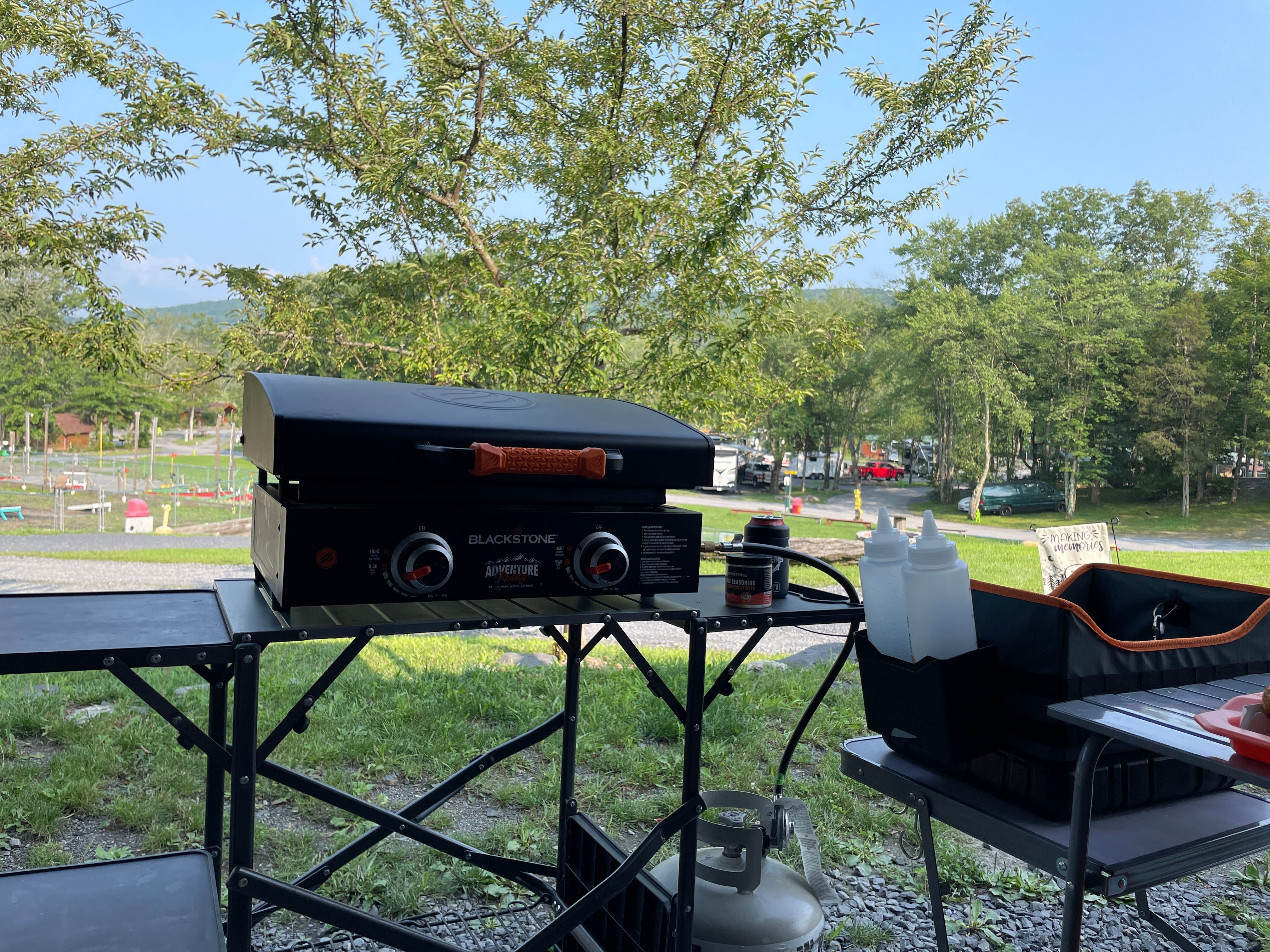
Ok, I said not to lug around propane. This was before I learned how to PROPERLY connect my gas line to the quick connect.
To Outdoor Kitchen or Not to Outdoor Kitchen, That Is The Question.
Yes, I know some Shakespeare. Whether tis nobler in the mind than to suffer the slings and arrows…..or something like that. That was even WITHOUT looking it up!
Anyway.
The next question is WHEN should you setup your outdoor gourmet paradise? Well, this is really up to you. If you’re like me, you’re trying to get your setup simpler, and simpler, so you can setup and break down in record time like a Formula 1 pit crew.
Usually, I bring my whole outdoor setup on trips longer than a weekend, and try to travel as light as possible for short trips. Weekend trips are more for a quick unwinding, or getting away from home to take a breath. Longer trips, you’re living. You have to plan, shop, eat, in my case work sometimes, and have a bit of an agenda every day, even if its a loose and fuzzy one.
Indoor cooking is an option. But if you have the option to NOT heat up your camper, why would you? You also can’t always get takeout or eat out all the time, right? Or, you shouldn’t at least.
My family prefers outdoor cooking unless its high winds, winter temperatures, or extreme heat. As long as its not one of those conditions and its more than a weekend trip, we’re bringing the whole setup with us.
The answer to the “should I or shouldn’t I” bring your whole outdoor setup is really up to you. If you have a camper that has a functional outdoor kitchen (you can tell those who designed some of these outdoor kitchens never cooked a day in their lives), or a tiny camp stove, then you may not need to bring more than what you already have in stock. But if you’re like me that opted to NOT have an outdoor kitchen, and have to take it all with you, then you may only do it on long trips.
Cooking Is Memory, Cooking Is Love
The sharpest memories rarely announce themselves. They sneak in on a smell such as woodsmoke, sizzling oil, something sweet caramelizing in the open air — and suddenly you’re back. Kids laughing somewhere nearby, the world going quiet around the edges.
That’s what cooking for the people you love actually looks like most of the time. It isn’t always a holiday table or a birthday cake. Sometimes it’s a griddle at a campsite, a spatula in one hand, a drink in the other, and the people who matter most somewhere within earshot. You’re not just making food. You’re making the thing they’ll smell in twenty years and still feel something about.
I’ll close this article the same way I opened it: cooking is love. Not in some abstract way, but in the most literal sense. Every meal you make for someone is time you chose to spend on them. And there’s no better reminder of that than being outside, fire going, kids carrying on in the background, the whole world smelling exactly like where you want to be.
That is one of the many reasons why we chose this life, and year after year we strive to find more ways to stay on the road longer.